
by Susanna Brinnon
Sat, Aug 9 at 2:06 PM
On Tuesday August 5, 2025, Fayetteville’s City Council voted 5 to 1 to quietly push through a new citywide recycling program. There were no public meetings, discussions, or even announcements, except for two Council sessions in June and July. The change was backed by the Mayor and the Environmental Director, and might not be a bad idea — except that the current system had been hailed nationwide as a model for others to follow, and the new system leads to more contamination: the items we thought we had recycled may instead get dumped into the landfill.
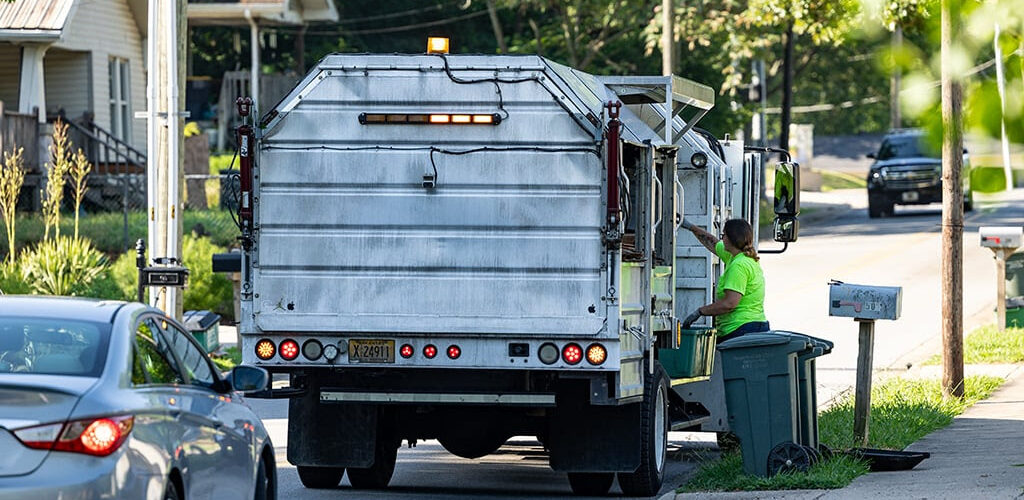
People who live in towns with this system, called “single stream” recycling or “cart-based” recycling, are often disgusted with it because of its hypocrisy. Instead of a worker sorting our recycled items at the curbside into truck bins of glass, paper, plastic, etc., all items are tossed into a truck by a machine, similar to our trash collection system. Needless to say, glass is broken, un-rinsed soda and yogurt containers spill, and other unmentionables spread everywhere. It’s then taken to a private facility where it is sorted by machine, with humans doing quality control in some fashion.
This new system is not just a proposal – it’s now a City Ordinance, set to take effect next year. And the only way to prevent its implementation is by lots of folks showing up at the next City Council meeting, Tuesday, August 19. At that meeting, the environmental director will request the Council’s approval to buy the new trucks needed for the new system. A few of us have been presenting our opposition at the two Council meetings so far; but apparently we have been unable to get their attention.
Is this what democracy looks like? We urge you to show up on 8/19 and, in the meantime, to write your City Councilor, the Mayor, the Environmental Director, and the newspapers. Attached is their contact information.
Here are comments from one observer of Tuesday’s session.
- Single Stream recycling has a proven record of inefficiency, with high contamination and landfill potential: it is a messy and inefficient method of recycling, resulting in a very high percentage of items going to the landfill due to contamination.
- Residents in opposition: The residents that knew of this proposal that attended the City Council Meeting August 5th spoke in opposition to the proposal with concrete facts why not to adopt it:
- Disreputable company taking it on
- No transparency
- Facts to prove single stream is very flawed and will result in most items going to landfill
- The public not being informed
- Subclauses that may hinder private recycling endeavors
- City Council: Lack of response to overwhelming rejection of proposal and quickly voting yes to proposal indicated council members are NOT representing their ward residents. They also spent $111,858 of City funds on a study of our recycling fees, instead of improving what we already have.
- Raised fees: over the next 3 years what we pay for recycling will be 20% more than charged now, for an inefficient system, instead of improving our system that is in place.
- Privatization of our recycling program with an out-of-town company.
- Article in Fayetteville Flyer grossly misleading with much disinformation. For example, all the other cities in NWA use single stream recycling, and their average contamination rate is 43%. Fayetteville’s is less than 1% with our current system; why would we want to change that? A report by the Journal of Waste Management and Container Recycling Institute says that sometimes there is so much contamination in single stream that the entire truck contents go to the landfill.
- The one Councilor who voted no, Council member Turk, gave a report with many challenges to the city’s hurried decision, including inaccurate data in the private consultant’s report, which the single stream proposal was based on. She raised many questions in her presentation, but there was little response from other Council members; instead the vote was all others in favor, without discussion.
- Finally, the new system does not include recycling of glass, or cardboard. These items have been the most lucrative for the city – why would we consider discontinuing them? The environmental director responded at the meeting, saying that there would have to be a second truck coming by later to collect the glass – but this is not documented in the report, and there are no estimates of the cost of this extra system, nor any detail on it. What’s up?
- Do your own research – and contact City Council.
Stay cool  Susanna